
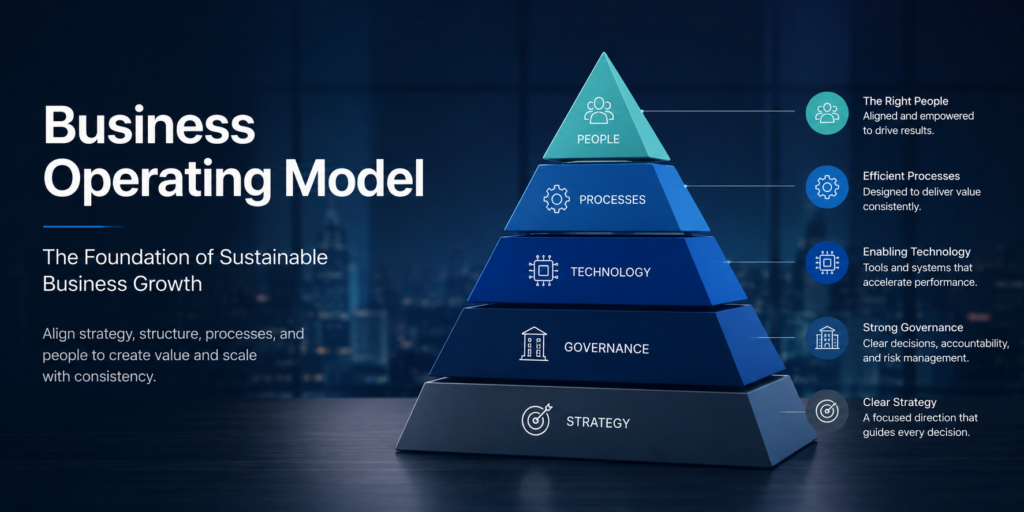
Every successful company is built on more than a great product or a strong vision. Behind every scalable organization lies a well-designed business operating model that defines how the company creates value, delivers results, and adapts to change.
While many businesses focus on strategy, an operating model determines whether that strategy can actually be executed. It connects people, processes, technology, governance, and decision-making into a system that supports long-term growth.
What Is a Business Operating Model?
A business operating model is the framework that explains how an organization operates on a daily basis to achieve its strategic objectives. It outlines how different teams work together, how decisions are made, how resources are allocated, and how value is delivered to customers.
Unlike a business model, which explains how a company generates revenue, an operating model focuses on how the business functions internally to execute its strategy effectively.
In simple terms:
- Business Model: How the company makes money.
- Business Operating Model: How the company delivers on that promise.
Organizations that understand this distinction are better equipped to scale efficiently while maintaining operational excellence.
Why a Business Operating Model Matters
Many companies experience rapid early growth but struggle as complexity increases. Teams become disconnected, decision-making slows, and operational inefficiencies begin to limit progress.
A strong business operating model provides clarity by creating repeatable systems that support sustainable growth.
Key benefits include:
- Faster decision-making
- Better collaboration across departments
- Greater operational efficiency
- Improved customer experience
- Clear accountability
- Easier expansion into new markets
- Stronger resilience during periods of change
Rather than relying on individual talent alone, successful businesses rely on systems that consistently produce results.
Core Components of a Business Operating Model
Although every organization is different, most operating models include several essential components.
Strategy Alignment
Every department should understand how its work contributes to the company’s overall objectives. When strategy and execution remain aligned, organizations can move faster while avoiding conflicting priorities.
Organizational Structure
The structure defines reporting lines, responsibilities, and ownership. Whether centralized or decentralized, the goal is to ensure that decisions are made by the people closest to the relevant information.
Processes
Documented and repeatable processes reduce friction across the business. From customer onboarding to product development, standardized workflows improve consistency and efficiency.
Technology
Modern operating models depend on technology that supports communication, automation, analytics, and collaboration. The right systems enable teams to work smarter rather than simply harder.
Governance
Clear governance establishes how decisions are made, who approves investments, and how performance is measured. Without governance, even talented organizations often struggle with inconsistent execution.
Performance Measurement
Metrics allow leaders to evaluate whether the operating model is delivering expected outcomes. Effective organizations focus on meaningful KPIs that reflect customer value, operational efficiency, and long-term growth.
Characteristics of an Effective Business Operating Model
There is no universal operating model that works for every company. However, successful organizations often share several common characteristics.
First, they maintain simplicity wherever possible. Complexity creates unnecessary delays and confusion.
Second, they remain adaptable. Markets evolve, customer expectations change, and technology continues to advance. A flexible operating model allows businesses to respond without disrupting core operations.
Third, accountability is clearly defined. Every initiative has an owner, every process has measurable outcomes, and every decision has a responsible stakeholder.
Finally, communication flows efficiently across the organization. Information reaches decision-makers quickly, reducing bottlenecks and improving execution.
Common Challenges
Designing a business operating model is only the beginning. Maintaining it requires continuous improvement.
Common challenges include:
- Unclear responsibilities
- Legacy processes that slow execution
- Poor cross-functional collaboration
- Technology fragmentation
- Resistance to organizational change
Companies that regularly review and refine their operating models are more likely to sustain growth over the long term.
Building a Business Operating Model for Growth
Developing an effective operating model starts with understanding your strategic priorities. Leaders should identify how value is created, where operational bottlenecks exist, and which capabilities will become increasingly important as the business grows.
From there, organizations can redesign processes, improve governance, invest in technology, and strengthen collaboration between teams.
The objective is not simply to optimize today’s operations but to build a framework that supports future opportunities.
Final Thoughts
A well-designed business operating model is one of the most valuable assets an organization can develop. It transforms strategy into execution, enables sustainable growth, and provides the structure required to navigate increasingly complex markets.
Companies rarely succeed because of vision alone. They succeed because they build operating systems capable of consistently delivering results.
Organizations that invest in improving their business operating model create a stronger foundation for innovation, expansion, and long-term competitive advantage.